
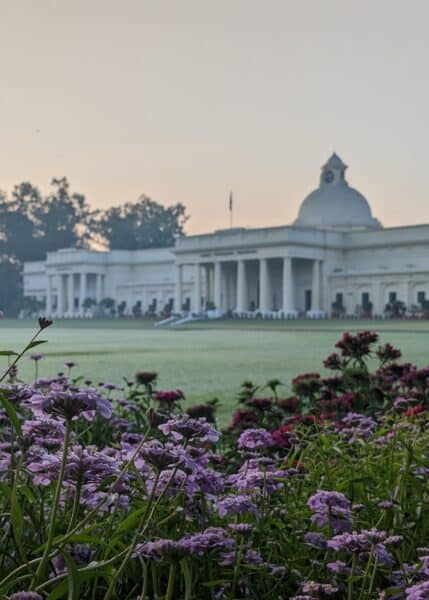
We look forward to welcoming registered participants to IIT Roorkee in November.
Programme
Day 1 Monday, 16 November 2026
| 9.30am | Inauguration and Welcome Address including public talk: “Markets, Science, Net Zero: Designing Effective Carbon Policy” by Dr. Suzi Kerr (Network Director, RESET) |
| 10:45am | High Tea |
| 11.00am | Panel Discussion: Bridging Modelling Research and Policy Practice Moderated discussion with modellers and policymakers on the gaps and alignment between modelling and practice, and how these can be strengthened. |
| 12.00pm | Working Group Pitches |
| 12:10pm | Technical Sessions I Parallel sessions Track A: Hands-on Session: Introduction to the SWITCH Model – Ashish Saraswat Track B: Emissions Trading Systems (ETS) – Dr. Suzi Kerr |
| 1:20pm | Lunch |
| 2:20pm | Carbon Credit Trading Scheme (CCTS) – Dr Arvind Bisht & Ankit Sharma |
| 3:50pm | Tea break |
| 4:00pm | Working Group Discussions (finish 5.30pm) |
| 7:30pm | Networking Gala Dinner |
Day 2 Tuesday, 17 November 2026
| 9.00am | Working Group Discussions |
| 10:15am | Tea and Networking |
| 10:25am | Working Group Discussions – Wrap up |
| 10:55am | Final Workstream Reporting |
| 11.25am | Reflections and Future Direction – RESET group |
| 12pm | Departure for Rishikesh (Lunch and Ganges Aarti) |
Working Group Themes
All RESET Asian Meet participants will join one of four groups for Working Group sessions over the two days. The themes for each working group in 2026 are:
Theme One: Coal communities and just transition:
Theme Leader: Rohit Azad
Will India shoot itself in the foot by closing the coal option?
Given India’s heavy dependence on coal, the dirtiest of the fossil fuels, moving away from it is fraught with political, economic and financial problems. What could be better for an area of research than this where questions are not settled, and the pathways are muddled with contradictions?
This theme addresses three questions:
- How will the workers, especially those in the informal sector (and their families) and the ancillary economy, be sustained?
- How broad is our definition of ‘just’ transition? Issues of community development?
- How will this transition be financed?
Together, this working group will create a policy brief which looks at the macro picture of just transition from an intersecting lens of science, politics and economics.
Rohit Azad is an economist specialising in the political economy of climate change.
Suggested reading:
- Just Nature: How finance can support a just transition at the interface of action on climate and biodiversity
- UN Environment Programme: I Finance Initiative I Just Transition
Theme Two: Regulation, Tarrifs, and Pricing
Theme Leader: Kanishka Kacker
Why do some policies for the energy transition get adopted while others are proposed again and again and never arrive? We take the hardest case — closing a power plant that still earns — and ask what makes an instrument adoptable at all.
China is on course to miss its own five-year retirement target for coal plants. India’s planner advised utilities in 2023 not to retire any thermal unit before 2030, and its long-term plan now runs coal capacity to roughly 315 GW by 2035–36. The first large transition finance packages have arrived mostly as loans, which add claims rather than absorbing them.
The gap between new investment in renewables and low retirement of thermal power is what the session is about. New investment creates a payment stream for an owner. Closing a plant ends one. Does this explain the gap? If the explanation holds, transition finance is better understood as supplying a party able to absorb loss, which would change how those packages are designed.
This theme asks:
- When a policy imposes a cost, who is told at the time that they will bear it, and who ends up bearing it?
- What has been proposed repeatedly and never adopted, and what do those proposals have in common?
- Where a hard adjustment did happen at scale, what was attached to it?
This group will work on a coded census of transition instruments from the countries in the room, an agreed protocol for coding them, and an outline for a qualitative comparative paper. The purpose of working the cases together is to find the question underneath that can be identified properly, with data and a design.
Kanishka Kacker is Assistant Professor, Economics, Indian Statistical Institute, Delhi working on energy/environment
Suggested reading:
- CREA and Global Energy Monitor, China coal power review, H1 2026
- The economics of coal phaseouts: auctions as a policy instrument for the energy transition
Theme Three: Transport and Electricity Demand Response
Theme Leader: Anshuman Tiwari
Can demand response enable transport electrification to deliver environmental benefits?
The electricity and transport systems of the Global South are seeing rapid change, with renewables and electric vehicles making rapid advances. Yet, in many if not most of these contexts, fossil fuel-based power generation will remain high for a long time as demand for electricity grows rapidly too. If EV batteries are charged during hours of day when electricity is primarily from fossil fuels, the environmental benefits of EVs will not materialize (on both local air pollution and global GHGs). Demand response offers a potential solution to align EV charging to renewable-rich hours, enabling the Global South to realize environmental benefits at least cost.
This theme will asks:
- How amenable are different vehicle categories to electrification today? What is the scope of demand response for these categories? What are some important open questions?
- What are the similarities and differences between the Economics perspective and the Energy Systems modelling perspective? What can we learn from each other?
This group will work towards a policy brief, with additional outputs to be agreed as a group.
Anshuman conducts research to inform public policies that will enable sustainable economic growth in LMICs.
Suggested reading:
Theme Four: Emissions Trading Markets
Theme Leader: Suzi Kerr
What are the opportunities and challenges with developing emission trading for the unique conditions in the Global South and how can our research make these systems more effective for accelerating just energy transition
Many countries in the Global South have recently implemented or are planning emissions trading systems. Those that are emerging (e.g. in China and India) are different from the existing examples in the Global North as countries try to adapt the basic ideas for their different goals and local conditions and all systems are still evolving. Strong research and engagement early in the design and implementation process can potentially avoid some problems (e.g. windfall gains, fraud, low prices, political instability that have been experienced in the first markets in EU, NZ and California) and make them effective faster.
This theme addresses three questions:
- In your country what are the specific local goals and local challenges with emissions trading?
- What existing knowledge, from global or local experience or research, can help and where do you see critical gaps?
- What types of research (questions, methodologies) could be done to address those gaps?
This group will develop a paper identifying key design and implementation issues where research in the Global South could make a difference and a partial research agenda including researchable questions and potential methodologies.
Suzi Kerr is Senior Advisor, Economics and Carbon Pricing at EDF based in New Zealand.
Suggested reading:
- Emissions Trading in Practice: a handbook on design and implementation
- Climate Action Teams (CAT): mini-lateral cooperation to accelerate ambitious decarbonization
Registration and Attendance Details
Registration for this event is now closed. Details of venue, maps, attendee resources, and logistics are available to attendees via the google drive link sent by email.
This event is organised by the RESET Network and hosted by the Department of Management Studies, Indian Institute of Technology Roorkee, Uttarakhand – 247667, India, with the support of the Environmental Defense Fund (EDF)
