
Resource Library / Discussion Paper / Electricity Retail Pricing as Incentives for Load Optimization in Vietnam
Electricity Retail Pricing as Incentives for Load Optimization in Vietnam
Discussion Paper
20 June 2026
Abstract
Vietnam’s pathway to net-zero emissions by 2050 has so far relied primarily on large-scale renewable energy investments, with limited use of demand-side management. This study evaluates how alternative retail electricity pricing schemes – flat tariffs, Time-of-Use (TOU), Critical Peak Pricing (CPP), and a TOU–CPP hybrid – shape demand flexibility, system costs, emissions, consumer welfare, and reliability in Vietnam. The analysis uses SWITCH 2.0, an integrated capacity expansion and dispatch model with an explicit demand-response module.
The results show that TOU pricing consistently outperforms flat tariffs and CPP. Relative to flat pricing, TOU reduces total system costs by up to 15%, lowers CO2 emissions by 8–12%, and increases the share of modern renewable generation from about 53% to over 63% by 2050, while improving consumer welfare. CPP alone delivers weaker cost and welfare outcomes, reflecting its limited ability to promote sustained intra-day load shifting. A TOU–CPP hybrid provides only modest additional cost or welfare gains compared with TOU, but achieves further emissions reductions by targeting extreme peak hours. Tariff design matters: consecutive TOU blocks balance efficiency and usability; while dynamically assigned blocks reduce congestion and costs further but require strong data and forecasting capacity. Pricing reform alone is insufficient, as shifting demand toward solar-rich hours creates new daytime peaks and transmission congestion. Overall, a staged transition toward a TOU-based scheme, complemented by grid reinforcement and data infrastructure and supported by gradual implementation and appropriate safeguards to ensure broad participation, offers a pragmatic pathway to enhance system efficiency, renewable integration, emission reductions, and welfare outcomes in emerging power systems.
Summary
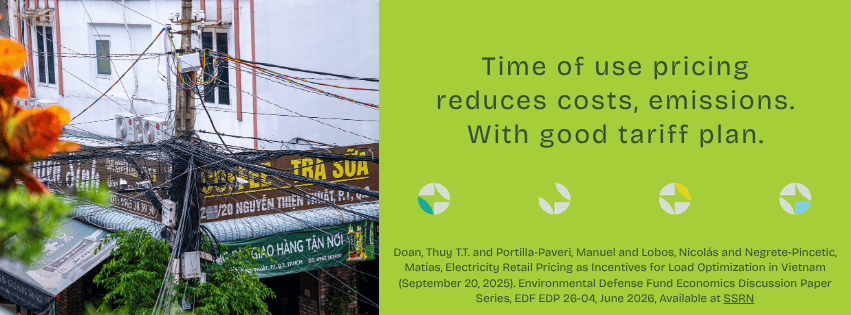
Time of use pricing
reduces costs, emissions.
With good tariff plan.
Vietnam aims to hit net-zero emissions by 2050, and so far the country’s strategy has leaned heavily on building large amounts of renewable energy capacity, with little attention paid to managing electricity demand. This study asked whether changing how electricity is priced might help. Using a detailed power system model (SWITCH 2.0), researchers tested four different electricity pricing approaches: a flat rate (same price all day), time-of-use pricing (higher prices at peak times, lower at off-peak), critical peak pricing (a price spike during the highest-demand hours), and a hybrid combining the two.
Time-of-use pricing was most effective. Compared to a flat rate, it cut total system costs by up to 15%, reduced emissions by 8–12% and nearly doubled the contribution of variable renewable energy to the grid by 2050. It also left consumers better off financially. Critical peak pricing on its own performed worse, since a single short price spike doesn’t encourage people to consistently shift their energy use throughout the day. Combining the two approaches added only a small additional benefit over time-of-use pricing alone, though it did help reduce emissions further by specifically targeting the most extreme demand peaks.
How the pricing scheme is designed also matters: simple, predictable pricing blocks are easier for people to use, while more flexible, data-driven pricing can save more money but requires stronger forecasting and data systems to implement.
Importantly, however, pricing reform isn’t a silver bullet. Shifting demand toward the times when solar power is abundant can create new strain on the grid during the day. The researchers conclude that the most realistic path forward combines smarter electricity pricing with upgrades to grid infrastructure and data systems, introduced gradually and with safeguards to make sure all consumers can participate and benefit.
Presented At/Published In
Environmental Defense Fund Economics Discussion Paper Series
Country
 Vietnam
Associated Resources
Citation
Doan, Thuy T.T. and Portilla-Paveri, Manuel and Lobos, Nicolás and Negrete-Pincetic, Matías, Electricity Retail Pricing as Incentives for Load Optimization in Vietnam (September 20, 2025). Environmental Defense Fund Economics Discussion Paper Series, EDF EDP 26-04, June 2026, Available at SSRN