
Resource Library / Journal Article / Assessing readiness for CC(U)S: are we there yet?
Assessing readiness for CC(U)S: are we there yet?
Journal Article
5 October 2026
Abstract
Given the slow progress on climate mitigation across the world, the need for carbon capture and storage (CCS) to reduce carbon dioxide (CO2) emissions is being increasingly discussed across society. However, the public remains ignorant of CCS and the role it may play in reducing CO2 emissions. This means responses to CCS projects can be reactionary rather than based on knowledge of CCS project attributes. To overcome this gap, we used a Discrete Choice Experiment, to investigate: (i) under what conditions do individuals choose a CCS project (or not)? and (ii) what are the attributes that influence preferences for the different forms of CCS? This was seen as a way to address the shortfall of previous public perception research by focusing on the different attributes of CCS projects. We used a market research company to conduct an online survey across seven countries (N=7264) including Australia, the United Kingdom, the United States, Canada, Denmark, Brazil and Indonesia. While there were small differences in preferences across countries, all respondents preferred projects that showed higher benefits – maximising the CO2 captured for the lowest cost. The other finding was that respondents were less likely to choose projects storing CO2 locally. These three findings highlight the areas that require most attention for communicating and engaging communities for local CCS projects. While not insurmountable, there is a need to ensure financing CCS projects do not become a burden on the public through subsidies. A more nuanced approach is required to ensure CCS becomes mainstreamed into global mitigation strategies.
Summary
With global progress on cutting emissions moving slowly, carbon capture and storage (CCS) is attracting attention as a way to reduce carbon dioxide (CO2) emissions. Most people know little about CCS, so the researchers surveyed more than 7,000 people online across seven countries: Australia, Brazil, Canada, Denmark, Indonesia the United Kingdom, and the United States.
Participants were shown pairs of hypothetical CCS projects with different features, such as cost, how much CO2 they capture and where the CO2 is stored, and asked which they would choose, if either.
Key findings:
- Preferences were similar across countries, with only small differences.
- People favor value for money. They preferred projects that capture more CO2 at a lower cost.
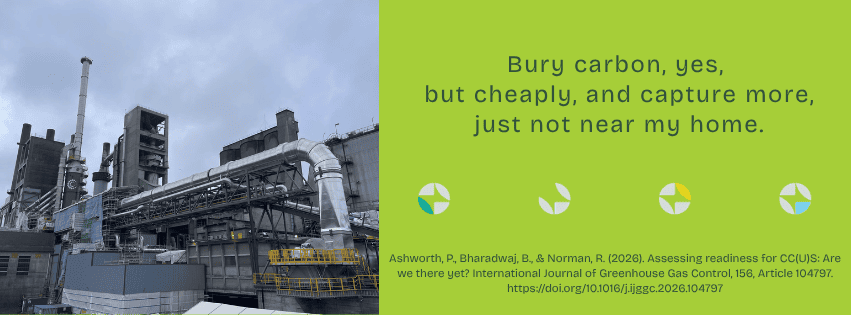
- People prefer storage away from home. Respondents were less likely to choose projects that store CO2 near where they live. This was especially true in Indonesia, with Brazil also expressing high NIMBY preferences
Global South respondents preferred bioenergy with carbon capture and storage (BECC), and capture from power plants compared to the base, low-carbon hydrogen. Indonesians showed the highest and significant preference for the use of pipelines, with Brazil coming in third highest.
The authors’ overall conclusion is that the public may not yet be ready to embrace CCS, and a more careful, nuanced approach is needed if it is to become part of mainstream climate strategies worldwide.
Presented At/Published In
International Journal of Greenhouse Gas Control
Country
 Multi-Country
Associated Resources
Citation
Ashworth, P., Bharadwaj, B., & Norman, R. (2026). Assessing readiness for CC(U)S: Are we there yet? International Journal of Greenhouse Gas Control, 156, Article 104797. https://doi.org/10.1016/j.ijggc.2026.104797