
Resource Library / Journal Article / Institutionalized resource nationalism: A global index of policy intervention and implications for the energy transition
Institutionalized resource nationalism: A global index of policy intervention and implications for the energy transition
Journal Article
14 May 2026
Abstract
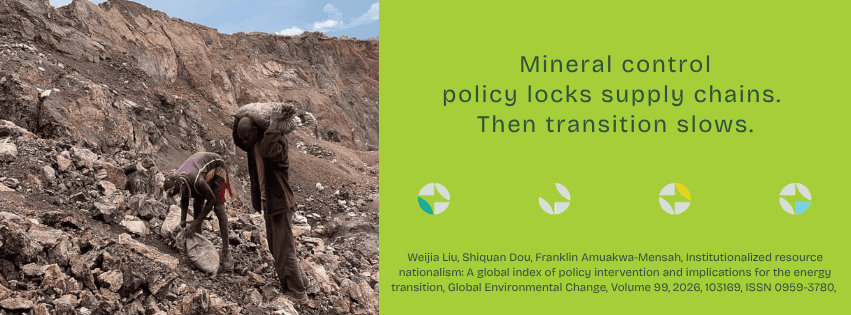
Governance that shapes access to critical minerals is becoming a key constraint on the global energy transition. Demand is rising, while national policy interventions in mineral supply chains are increasing. These changes affect supply security and the pace of decarbonization. However, the systemic risks across countries and policy tools remain poorly measured. We construct a global resource nationalism risk index for major economies from 2000 to 2023. Policy measures are converted into a comparable scale of intervention intensity and combined with mineral production structures to estimate supply risk. We find that resource nationalism is no longer confined to traditional resource exporters. High-income economies are increasingly involved. Risks are also becoming more concentrated among a small number of major producers. These risks propagate through global supply chains, placing growing pressure on the energy transition.
Summary
Critical minerals such as lithium, cobalt and rare earth metals are all important in building solar panels, batteries and wind turbines. Governments around the world are increasingly stepping in to control who can access these minerals, through export bans, ownership rules and other policy interventions. This report examines how often this is occurring and what it means for the global shift to clean energy.
To do this, the researchers built a new index that tracks government interventions across major economies from 2000-2023 to compare and measure intervention in mineral supply chains.
They found that intervention comes from wealthy industrialized nations, not just traditional mineral-exporting economies in the Global South. They also found a shrinking number of major producing countries account for a growing share of global supply risk. Because mineral supply chains are global, the choices an individual county’s government makes can ripple across borders. As more countries adopt policy interventions the combined effect could become a systemic barrier to decarbonizing the world’s energy systems.
This research provides a transparent way to measure that risk, helping decision-makers see where the pressure points are.
Presented At/Published In
Global Environmental Change
Country
 Multi-Country
Associated Resources
Citation
Weijia Liu, Shiquan Dou, Franklin Amuakwa-Mensah, Institutionalized resource nationalism: A global index of policy intervention and implications for the energy transition, Global Environmental Change, Volume 99, 2026, 103169, ISSN 0959-3780, https://doi.org/10.1016/j.gloenvcha.2026.103169