
Resource Library / Journal Article / Techno-economic optimization of hydrogen refueling infrastructure for corridor-based heavy-duty freight
Techno-economic optimization of hydrogen refueling infrastructure for corridor-based heavy-duty freight
Journal Article
1 October 2026
Abstract
Hydrogen fuel cell electric trucks represent a promising pathway for decarbonizing long-haul freight, yet large-scale deployment remains constrained by high infrastructure costs and uncertainty surrounding where refueling infrastructure should be located, particularly in developing economies with complex geography. This study presents an integrated techno-economic and optimization framework that couples a physics-based vehicle digital twin, site-specific hydrogen production cost modeling, and mixed-integer linear programming optimization to design cost-effective hydrogen refueling hub networks along strategic freight corridors. The framework explicitly captures real-world topography, traffic conditions, and payload variability to simulate hydrogen demand for a heavy-duty fuel cell truck, and computes location-dependent levelized cost of hydrogen using hybrid renewable–grid production systems. These outputs inform a corridor-level optimization that jointly determines the siting and sizing of refueling hubs while balancing total system cost and spatial accessibility. Applied to a major freight corridor in a mountainous developing-country context, the optimized network supplies 2295 kg of hydrogen per day through eleven hubs with capacities ranging from 50–340 kg d, achieving full corridor coverage with maximum spacing consistent with international corridor standards. Relative to diesel operation, the optimized configuration avoids approximately 7036–7204 tCO yr for a fleet of 50 trucks (net of grid carbon contribution), while highlighting key economic sensitivities related to electrolyzer capital costs, discount rates, and electricity tariffs. Beyond the specific application, the proposed framework provides a transferable and policy-relevant blueprint for hydrogen infrastructure planning in emerging economies, enabling evidence-based prioritization of hydrogen investment along high-impact freight routes and supporting the implementation of national decarbonization strategies.
Summary
Trucks powered by hydrogen fuel cells could help cut emissions from long-distance freight, which is otherwise hard to decarbonize. Building refueling stations is expensive, however, and it’s often unclear where they should be located, especially in developing economies with challenging geography.
This study offers a planning tool to answer that question, which can be adapted to other freight routes with different geography and energy systems, giving planners in emerging economies an evidence-based way to decide where hydrogen investment would have the greatest impact
The tool combines:
- A “digital twin” of a heavy-duty hydrogen truck, which simulates how much fuel the truck uses on a real route, taking into account hills, traffic and the weight of its load.
- Local hydrogen cost estimates, which calculate what it would cost to produce hydrogen at each possible site using a mix of renewable energy and grid electricity.
- An optimization model, which decides where to build refueling hubs and how big each should be, balancing overall cost with making sure trucks can always reach a station.
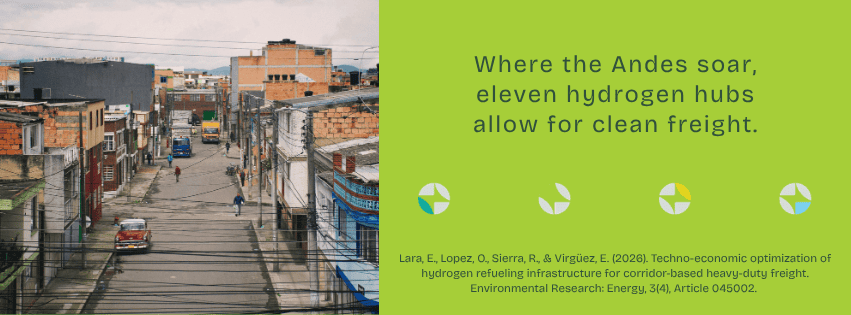
The researchers applied the tool to the mountainous freight route between Bogotá and the port of Buenaventura in Colombia.
Key findings:
- Eleven hubs cover the whole route, supplying about 2,300 kg of hydrogen a day, with station spacing in line with international standards.
- A fleet of 50 hydrogen trucks would avoid around 7,000 tonnes of CO2 a year compared with diesel trucks, after accounting for emissions from grid electricity.
- Planning based only on the lowest production cost leaves dangerous gaps in mountainous sections. Station accessibility needs to be built into the planning from the start.
- Hydrogen is close to competitive, with costs ranging from about US$3.80 to US$5.00 per kilogram depending on location, roughly 20% above the cost of diesel. Policy measures such as tax credits, low-cost finance and carbon credits could bring this down to about US$2.30–3.60 per kilogram, closing the gap with diesel.
The main barriers to hydrogen freight corridors are less technological and more about policy design, financing and securing demand from freight operators.
Presented At/Published In
Environmental Research: Energy
Country
 Colombia
Associated Resources
- Alternative Scenarios for Low-Carbon Transport in Nigeria: A Long-Range Energy Alternatives Planning System Model Application
- Sustainable energy pathways for land transport in Nigeria
- Lithium Constraints on India’s Transport Electrification: System-Level Impacts and Policy Implications for the Net-Zero Transition
Citation
Lara, E., Lopez, O., Sierra, R., & Virgüez, E. (2026). Techno-economic optimization of hydrogen refueling infrastructure for corridor-based heavy-duty freight. Environmental Research: Energy, 3(4), Article 045002. https://doi.org/10.1088/2753-3751/aea79c