
Resource Library / Journal Article / How hard are hard-to-abate sectors? Rethinking industrial decarbonization pathways
How hard are hard-to-abate sectors? Rethinking industrial decarbonization pathways
Journal Article
21 August 2026
Abstract
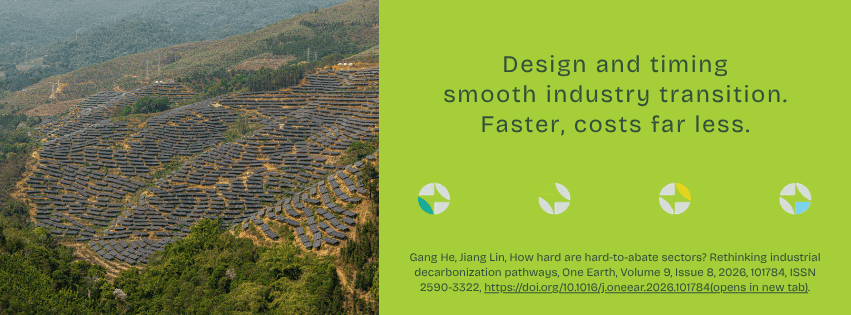
Industrial decarbonization is widely regarded as one of the most difficult and costly challenges, or “hard-to-abate,” in achieving net-zero emissions. Recently in Joule, Dai and colleagues demonstrated accelerated decarbonization pathways at lower costs for China’s industrial sector. Here, we argue that coordinated, system-wide transitions can accelerate learning, lower costs, strengthen competitiveness, and offer implications for global industrial decarbonization.
Summary
The industrial sector is often regarded as the hardest and most expensive part of transitioning to a net-zero future. A recent modelling study of China’s industrial sector (Dai et al., in Joule), found that moving faster on industrial decarbonization could lower total costs by around 8% (roughly USD 1.8 trillion) between now and 2060, while preserving more of the remaining global carbon budget.
This commentary on that paper reasons that this cost saving is the result of early, coordinated investment, which avoids three costly traps:
- The cost of technological learning falls as production scales up, e.g. solar costs have dropped more than 90% over the past decade
- Early action avoids locking in carbon-intensive infrastructure or stranding these expensive assets.
- Coordinating industrial policy with electricity, hydrogen, and carbon transport infrastructure unlocks efficiencies that don’t exist if sectors plan independently.
The design and timing of a transition therefore matter as much as having a stringent emissions target. While China is an instructive proof of concept, it can’t be a template for other countries as institutional capacity, access to capital and resource endowments vary widely. Governments elsewhere will need to address how to:
- Achieve system-wide economies in market economies with many independent actors
- Speed up permitting and public acceptance for hydrogen and transport electrification
- Ensure fair distribution of costs and benefits of industrial transitions
Presented At/Published In
One Earth
Country
 China
China
 Multi-Country
Associated Resources
- Comparative Analysis of Energy System Modeling Approaches for Decarbonizing the Electricity Sector
- Fossil Fuel Lock In vs. Clean Power: Pathways for the Developing Asian Region by 2050-2060
- SWITCH Model Adaptation for China
- Rapid cost decrease of renewables and storage accelerates the decarbonization of China’s power system
- How hard are hard-to-abate sectors? Rethinking industrial decarbonization pathways
Citation
Gang He, Jiang Lin, How hard are hard-to-abate sectors? Rethinking industrial decarbonization pathways, One Earth, Volume 9, Issue 8, 2026, 101784, ISSN 2590-3322, https://doi.org/10.1016/j.oneear.2026.101784(opens in new tab).