
Resource Library / Journal Article / Urban cooking in the global south: Social dimensions, urgency, and climate mitigation potential
Urban cooking in the global south: Social dimensions, urgency, and climate mitigation potential
Journal Article
1 November 2026
Abstract
Home cooking is an essential socio-cultural practice in the Global South shaped by shared meanings. Cooking fuel transition is a complex issue. It involves social and political economy contexts, household experiences, motivation, perceptions, justice and inclusivity, over and above technology supported by appropriate infrastructure access. Evidence on comprehensive, realistic, empirically grounded pathways for durable cooking fuel transitions remains limited. This systematic review synthesizes evidence from 42 studies from 50 cities in the Global South. The technical mitigation potential estimate is ~0.043 GtCO₂ by 2035. Indicative cost is USD 47.6–75.7/tCO₂. Health, economic, social and environmental benefits make the transition techno-economically attractive. Feasibility of transition across six dimensions identifies economic and socio-cultural constraints as the most pervasive barriers and deeply entrenched reasons. Institutional feasibility depends on cross-sector policy coherence. Informal settlements, where 16% of urban households globally rely on solid fuels for cooking, remain a hard-to-abate segment for the cooking fuel transition owing to the complex political economy of development patterns and governance landscapes. Overall, the study identifies three policy priorities for a durable and inclusive transition: gender-inclusive and equity-sensitive financial instruments; investment to ensure supply chain security and provide access to reliable energy services; and institutional arrangements for explicit LPG-to-decarbonized electric cooking for all in national energy roadmaps. To help overcome sticky socio-cultural habits, policies need to accommodate the time needed for an experiential journey through various fuel use by households to gain agency in making a choice toward cleaner fuel in the longer run.
Summary
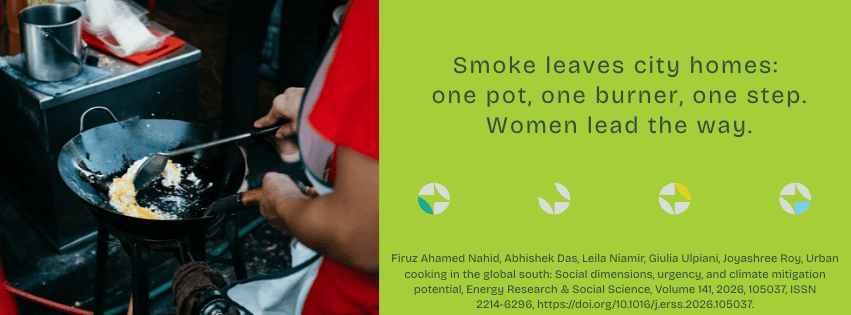
Many elements shape how people cook: home kitchen infrastructure, reliability of fuel supply, access and affordability of fuel and cooking equipment, household income, food preferences, and gender roles. Policies to enhance access to modern energy have not eliminated the use of polluting fuels in urban homes in the Global South, affecting family health and the environment.
This publication draws on evidence from studies covering 50 cities across 20 countries and focuses on the larger benefits of durable clean cooking transitions and where policy makers should focus to improve urban household cooking.
Key findings:
- Clean cooking improves physical and mental health, particularly for women and children, and saves cooking time.
- Shifting to electric cooking can technically reduce CO₂ emissions by 17–32 million tonnes by 2035.
- Geopolitical conflict-driven energy crisis sharpens the urgency: social practice, nutrition, energy security, and decarbonization imperatives are inseparable.
- Fuel security for household cooking can be managed by the decision to use several fuels to protect against price volatility and supply interruptions, and to meet specific cooking needs.
Cooking habits are deeply rooted in culture and daily routine, so they don’t change overnight. The study suggests policies should allow time for households to try different fuels and learn from experience, so that over time they feel able to choose cleaner options for themselves.
The researchers identified four priorities for an inclusive and lasting transition:
- Reliable fuel supplies and access to appliances and repair facilities.
- Targeted and affordable financial support designed with women and lower-income households in mind.
- Clear national plans: a defined pathway in national energy plans for moving households from LPG bottled gas to clean electric cooking for everyone.
- Roadmap and program designs that are informed by women’s experiences and sensitive to various kitchen infrastructure.
Presented At/Published In
Energy Research & Social Science
Country
 Multi-Country
Associated Resources
- A Global and Inclusive Just Labor Transition: Challenges and Opportunities in Developing and Developed Countries
- An optimization model for low carbon electricity transition planning: a case study from India
- Clean cooking energy transition in Nigeria: Policy implications for Developing countries
- Fossil Fuel Lock In vs. Clean Power: Pathways for the Developing Asian Region by 2050-2060
- The use of plastic as a household fuel among the urban poor in the Global South
Citation
Firuz Ahamed Nahid, Abhishek Das, Leila Niamir, Giulia Ulpiani, Joyashree Roy, Urban cooking in the global south: Social dimensions, urgency, and climate mitigation potential, Energy Research & Social Science, Volume 141, 2026, 105037, ISSN 2214-6296, https://doi.org/10.1016/j.erss.2026.105037.